

Tinnitus in figures
The Apple Hearing Study (University of Michigan and Apple, 2024) reported that approximately 15% of more than 160,000 participants experience tinnitus daily, and that the prevalence of daily tinnitus increases with age.
The study also notes that tinnitus can affect sleep and concentration, and later updates from the same research team link tinnitus to mood regulation and stress.
These findings confirm that tinnitus is not merely an auditory symptom, but a multisystem phenomenon with broad emotional and physiological repercussions.
When the nervous system “goes on alert”
Hearing does not function in isolation. When the autonomic nervous system (ANS) becomes overactivated, the body enters a state of hypervigilance that can amplify perception of the “phantom sound” typical of tinnitus.
Recent studies have identified objective autonomic markers in people with severe tinnitus, including increased pupil dilation, altered facial micro-expressions in response to neutral stimuli, and a characteristic “fight-or-flight” response pattern.
This autonomic imbalance is associated with heightened distress, fragmented sleep and difficulty maintaining attention, reinforcing the connection between tinnitus, stress and ANS dysfunction.
NESA® neuromodulation and the autonomic nervous system
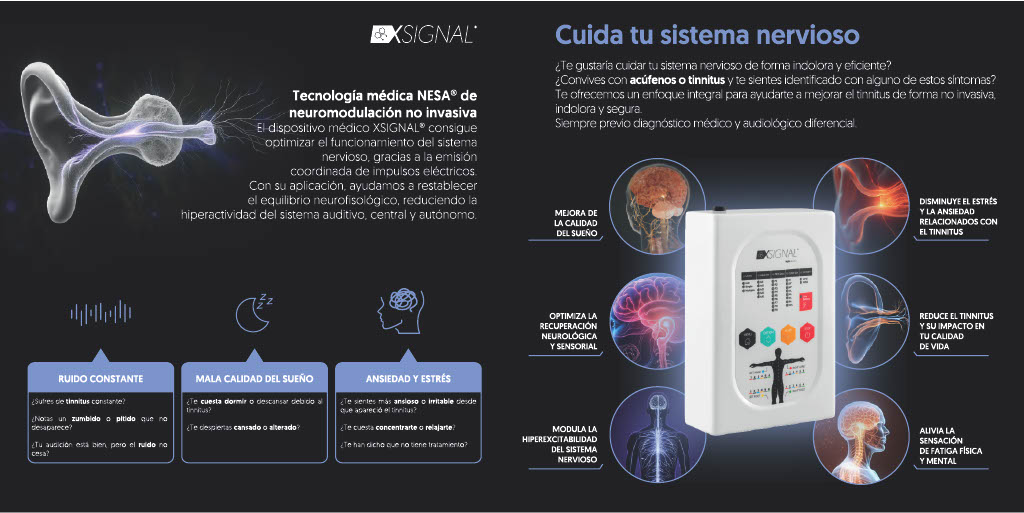
The NESA® XSIGNAL device delivers very low-intensity biphasic microcurrents (<<10 µA) via electrodes placed on the hands and feet, imperceptibly stimulating afferent and efferent fibres of the autonomic nervous system
Its aim is to restore bioelectrical balance and promote autonomic self-regulation through a safe, non-invasive stimulus.
The device holds CE medical certification, and its safety has been documented in multiple clinical studies, with no significant adverse effects reported after more than a decade of therapeutic use.
Main neurophysiological effects described:
- Modulation of autonomic tone, promoting parasympathetic predominance and reducing cortisol levels, a key biomarker of stress.
- Enhancement of alpha-wave and prefrontal activity, improving cortical noise filtering and reducing central auditory gain, mechanisms implicated in tinnitus.
- Stimulation of neural plasticity, influencing neurotransmitters such as melatonin and acetylcholine, which are central to auditory habituation and restorative sleep.

Clinical results observed
In specialised clinical practice, the NESA® protocol is often used in combination with hearing assessment, counselling, and sound-retraining or mindfulness exercises.
The most frequently reported outcomes include:
- Subjective reduction in tinnitus intensity, perceived by patients after several neuromodulation sessions.
- Reduction in tinnitus-related disability, assessed using the Tinnitus Handicap Inventory (THI).
- Increase in continuous sleep time and improved perceived restfulness.
- Decrease in physiological stress markers, such as morning salivary cortisol.
Although these observations arise from clinical practice rather than randomised controlled trials, they are consistent with findings in other populations treated with the same technology, such as athletes, who demonstrated normalisation of cortisol profiles and improved sleep latency, with no relevant adverse effects reported.
👉 Download the complete dossier here
Mechanisms that could explain the effect
While the specific physiological mechanisms of NESA® neuromodulation in tinnitus have not yet been conclusively established, current evidence on microcurrent stimulation and autonomic regulation allows the proposal of plausible hypotheses:
- Autonomic balance: possible reduction in the LF/HF ratio of heart rate variability, together with increased cholinergic activity, which may help to dampen central auditory amplification.
- Hormonal regulation: observed decreases in cortisol and a potential increase in melatonin may promote inhibitory plasticity and support restorative sleep.
- Specific plasticity: microcurrent stimulation could induce LTP/LTD-type neural modifications in auditory and limbic networks, facilitating tinnitus habituation and modulation of hyperactive circuits.
Relevance for healthcare professionals
- Provides a complementary, non-pharmacological option for cases of persistent tinnitus, particularly in patients showing signs of dysautonomia or chronic stress.
- Can be integrated within a multidisciplinary framework, alongside audiology, psychology, sleep medicine and neuromodulatory physiotherapy, promoting care centred on autonomic regulation and overall well-being.
- Opens new avenues for clinical research, including the use of autonomic biomarkers (e.g. heart rate variability and cortisol) and comparative studies with other neuromodulation techniques (TMS, tDCS, etc.), potentially broadening therapeutic frontiers in otoneurology and neurorehabilitation.
Next steps and collaboration
NESA® neuromodulation is emerging as a promising tool in the management of tinnitus and disorders associated with autonomic dysregulation.
However, its definitive validation requires multicentre controlled clinical trials, with comparative groups, longitudinal follow-up, and objective measurements of autonomic function and auditory perception.
Healthcare professionals and research institutions are encouraged to explore this technology, evaluate its potential across diverse clinical contexts, and participate in collaborative studies aimed at consolidating the scientific evidence base and optimising neurosensory rehabilitation strategies.
Final note: This content is for informational purposes only and does not replace individual clinical assessment or treatment. In cases of tinnitus, referral to specialists in otoneurology or audiology is always recommended.
References
Biesinger, E., Hesse, G., Probst, T., & Schäfer, C. (2025). Retrospective chart review demonstrating effectiveness of bimodal neuromodulation for tinnitus treatment. npj Primary Care Respiratory Medicine, 35, 29. https://doi.org/10.1038/s43856-025-00837-3
Lee, S. Y., Han, J. J., Choi, S., Lee, S., & Park, H. (2023). Objective multidisciplinary measurements of sleep and autonomic dysfunction as risk factors for chronic subjective tinnitus. Scientific Reports, 13, 261. https://doi.org/10.1038/s41598-022-26450-1
Lin, Y., Zhao, H., & Chen, J. (2025). Objective autonomic signatures of tinnitus and sound sensitivity disorders. Science Translational Medicine, 17(737), eadp1934. https://doi.org/10.1126/scitranslmed.adp1934
Marks, K. L., Martel, D. T., Wu, C., Basura, G. J., Roberts, L. E., Schvartz-Leyzac, K. C., & Shore, S. E. (2022). Different bimodal neuromodulation settings reduce tinnitus symptoms in a randomized clinical trial. Scientific Reports, 12, 10350. https://doi.org/10.1038/s41598-022-13875-x
Moghadam, M. H., Asadi, M., & Darvishi, E. (2025). Exploring the therapeutic potential of bimodal stimulation in tinnitus: A narrative review. Annals of Medicine and Surgery, 84, 104887. https://doi.org/10.1097/MS9.0000000000000887
Probst, T., Pryss, R. C., Schlee, W., & Langguth, B. (2023). The association between stress, emotional states, and tinnitus-related distress: A study of cortisol, BDNF, and hair analyses. Frontiers in Aging Neuroscience, 15, 1131979. https://doi.org/10.3389/fnagi.2023.1131979
Yakunina, N., & Nam, E. C. (2020). Stress and tinnitus: Transcutaneous auricular vagal nerve stimulation. Frontiers in Psychology, 11, 570196. https://doi.org/10.3389/fpsyg.2020.570196
National Institute for Health and Care Excellence (NICE). (2020). Tinnitus: Evidence review for neuromodulation. London: NICE. https://www.ncbi.nlm.nih.gov/books/NBK557035