
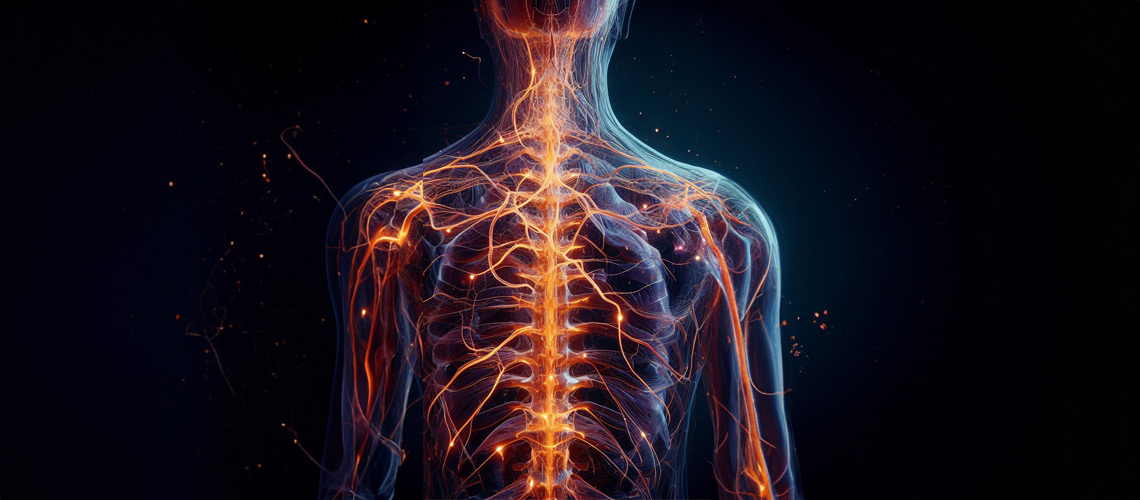
ANATOMICAL BASIS OF THE VAGUS NERVE
The vagus nerve is one of the most fascinating structures of the autonomic nervous system (ANS). As the longest cranial nerve in the human body, it connects the brainstem to the abdomen, interacting with vital organs such as the heart, lungs, and digestive system. It is a veritable “fast lane of communication” that regulates essential functions such as heart rate, respiration, digestion, and even immune responses¹.
At the heart of the parasympathetic system, the vagus nerve acts as the ‘rest and digest' team, balancing the effects of the sympathetic system, known for triggering the famous ‘fight or flight' response². In recent years, researchers have explored its link to mental health, showing how it can influence mood and stress². This research has opened doors to therapies targeting vagal tone, designed to treat disorders such as anxiety, depression, and other emotional conditions³.
Composed of 80% afferent fibres (carrying information to the brain) and 20% efferent fibres (sending commands from the brain to the organs), the vagus nerve is key to communication between the central nervous system (CNS) and the digestive system, often referred to as the “second brain”. This bidirectional interaction regulates not only physiological functions but also our general well-being⁴.
Who hasn't heard of the link between the “gut and mood”?
THE VAGUS NERVE AND THE AUTONOMIC NERVOUS SYSTEM
In the complex world of the ANS, the vagus nerve is a key player. It forms part of the parasympathetic division, promoting relaxation, digestion, and recovery—essential functions for maintaining balance in the face of the challenges of modern life.
In addition to facilitating digestion—by stimulating enzyme secretion and nutrient absorption—the vagus nerve slows the heartbeat and regulates blood pressure, stabilising it during periods of rest. When stress occurs, it also collaborates with the sympathetic system, adjusting blood flow to prepare the body for action⁵. Durante episodios de estrés, también colabora con el sistema simpático, ajustando el flujo sanguíneo para preparar el cuerpo para la acción⁵.
STRESS AND THE VAGUS NERVE
The relationship between stress and the vagus nerve is a vibrant area of research, demonstrating how emotions and physiology are intimately connected. Under stress, the HHA (hypothalamus-pituitary-adrenal) axis is activated, preparing the body for fight or flight. In this context, the vagus nerve acts as a ‘peacekeeper‘, regulating responses and promoting a state of calm⁶.
Recent studies show that the vagus nerve actively monitors bodily states, helping to regulate heart rate variability (HRV), suppress inflammation, and balance digestive functions. Its role is critical in managing chronic stress, one of today's greatest health challenges⁶.
ANTI-INFLAMMATORY EFFECT OF THE VAGUS NERVE
The vagus nerve is also a hero in the combat against inflammation. Through the “cholinergic anti-inflammatory pathway”, it reduces the release of pro-inflammatory cytokines, making it a valuable ally in conditions such as rheumatoid arthritis and inflammatory bowel diseases⁷.
Simple practices such as deep breathing, meditation, and yoga can increase vagal tone, helping the body fight inflammation and strengthen overall health. This positions the vagus nerve as a promising therapeutic target⁷.
But what if we told you there was an even more innovative way to give this inner superhero an extra boost? That's where NESA® Non-Invasive Microcurrents come in.
NESA NON-INVASIVE NEUROMODULATION AND THE VAGUS NERVE
NESA technology proposes an innovative and non-invasive approach to vagus nerve stimulation using imperceptible electrical microcurrents. This method, designed to act directly on the autonomic nervous system (ANS) pathways, uses intelligent electrical patterns that interact with key peripheral nerves, promoting not only balance and relaxation, but also the regulation of key autonomic functions in the medium to long term⁸,¹⁵.
Highlights – Neuromodulation of the ANS as a bridge to Vagus Nerve activation:
- Stimulation of the parasympathetic pathways: Microcurrents activate the vagus nerve, helping to regulate the nervous system and promoting states of relaxation.
- Stress Management: Modulation decreases sympathetic activity, reducing heart rate and cortisol levels.
- Neuroplasticity: Electrical stimuli promote changes in neural networks, adjusting the way the brain processes information.
- Pain Reduction: The technology interferes with nociceptive pathways, relieving chronic pain and specific conditions such as migraines.
- Sleep Quality: Modulation promotes deeper and more restful sleep cycles, improving overall well-being.
CONCLUDING REMARKS
The vagus nerve acts as a true bridge between the brain and the body, connecting fundamental systems and helping to maintain homeostasis. With the development of technologies such as NESA Non-Invasive Neuromodulation, new therapeutic perspectives are opening for the regulation of autonomic functions and the improvement of physical and mental health.
Stay tuned to discover how the team — the ANS and the Vagus Nerve are transforming the way we care for integrative wellbeing!
Bibliography:
- Kenny, B. J., & Bordoni, B. (2022). Neuroanatomy, Cranial Nerve 10 (Vagus Nerve). In StatPearls. StatPearls Publishing. PMID: 30725856
- Breit, S., Kupferberg, A., Rogler, G., & Hasler, G. (2018). Vagus nerve as modulator of the brain-gut axis in psychiatric and inflammatory disorders. Frontiers in Psychiatry, 9, 44. https://doi.org/10.3389/fpsyt.2018.00044
- O'Reardon, J. P., Cristancho, P., & Peshek, A. D. (2006). Vagus nerve stimulation (VNS) and treatment of depression: To the brainstem and beyond. Psychiatry (Edgmont), 3(5), 54–63. PMID: 21103178; PMCID: PMC2990624
- Li, M., Wang, H.-B., & Hashimoto, K. (2025). The vagus nerve: An old but new player in brain–body communication. Brain, Behavior, and Immunity, 124, 28–39. https://doi.org/10.1016/j.bbi.2024.11.023
- Rajiah, R., Takahashi, K., Aziz, Q., & Ruffle, J. K. (2024). Brain effect of transcutaneous vagal nerve stimulation: A meta-analysis of neuroimaging evidence. Neurogastroenterology and Motility, 36(8), e14484. https://doi.org/10.1111/nmo.14484
- Okonogi, T., Kuga, N., Yamakawa, M., Kayama, T., Ikegaya, Y., & Sasaki, T. (2024). Stress-induced vagal activity influences anxiety-relevant prefrontal and amygdala neuronal oscillations in male mice. Nature Communications, 15(1), 183. https://doi.org/10.1038/s41467-023-44205-y
- Bonaz, B. (2022). Anti-inflammatory effects of vagal nerve stimulation with a special attention to intestinal barrier dysfunction. Neurogastroenterology and Motility, 34(10), e14456. https://doi.org/10.1111/nmo.14456
- Medina-Ramírez, R., Mallol Soler, M., García, F., Pla, F., Báez-Suárez, A., Teruel Hernández, E., Álamo-Arce, D. D., & Quintana-Montesdeoca, M. d. P. (2024). The impact of the NESA neuromodulation technique on sleep and recovery processes in young professional basketball players: A preliminary study. Stresses, 4(2), 238–250. https://www.mdpi.com/2673-7140/4/2/14
- Teruel-Hernández, E., López-Pina, J. A., Souto-Camba, S., Báez-Suárez, A., Medina-Ramírez, R., & Gómez-Conesa, A. (2023). Enhancing sleep quality, reducing daytime sleepiness, and improving cognitive function in dementia patients through therapeutic exercise and NESA neuromodulation: A multicenter clinical trial. International Journal of Environmental Research and Public Health, 20(21), 7027. https://doi.org/10.3390/ijerph20217027
- Báez-Suárez, A., Padrón-Rodríguez, I., Castellano-Moreno, E., González-González, E., Quintana-Montesdeoca, M. P., & Medina-Ramirez, R. I. (2023). The utilization of noninvasive neuromodulation in pediatric patients with neurodevelopmental disorders to improve sleep quality and relieve constipation. BMC Pediatrics, 23(1), 465. https://doi.org/10.1186/s12887-023-04307-4
- Contreras, M., Medina-Ramírez, R., Teruel-Hernández, E., Vilchez-Barrera, M., Báez-Suárez, A., & Álamo Arce, D. (2023). Rehabilitation of sleep, pain, and bladder symptoms through the application of NESA neuromodulation in patients with multiple sclerosis: An innovative approach. CPQ Medicine Journal, 15(1). https://www.cientperiodique.com/article/CPQME-15-1-439.pdf
- García, F., Fernández, D., Vázquez-Guerrero, J., et al. (2022). Restoration of physiological status in professional basketball players via NESA neuromodulation treatment during various in-season microcycles: A preliminary randomized clinical trial. Frontiers in Physiology, 13. https://doi.org/10.3389/fphys.2022.1032020
- Bonilla-Eizaguirre, M., Martin, M., Hernandez-Perez, A., Vilchez-Barrera, M., Medina-Ramirez, R., & Báez-Suárez, A. (2024). Efficacy of NESA non-invasive neuromodulation in patients with post-traumatic cervicalgia. International Journal of Research and Scientific Innovation, 11(1). https://doi.org/10.51244/IJRSI.2024.1110038
- Vega-Delgado, N., García-Rodríguez, I., Saldanha, L., Báez-Suárez, A., & Medina-Ramírez, R. (2024). New frontiers in sleep disorders: The advent of an innovative non-invasive neuromodulation treatment. International Journal of Research and Scientific Innovation, 11(1). https://doi.org/10.51244/IJRSI.2024.11150049P
- Medina-Ramírez, R., Molina-Cedrés, F., Báez-Suárez, A., & Álamo-Arce, D. (2021). Nesa noninvasive neuromodulation: A novel frontier in the management of the autonomic nervous system in physiotherapy. CPQ Orthopaedics & Sports Medicine, 5(4). https://www.cientperiodique.com/article/CPQOS/5/4/97